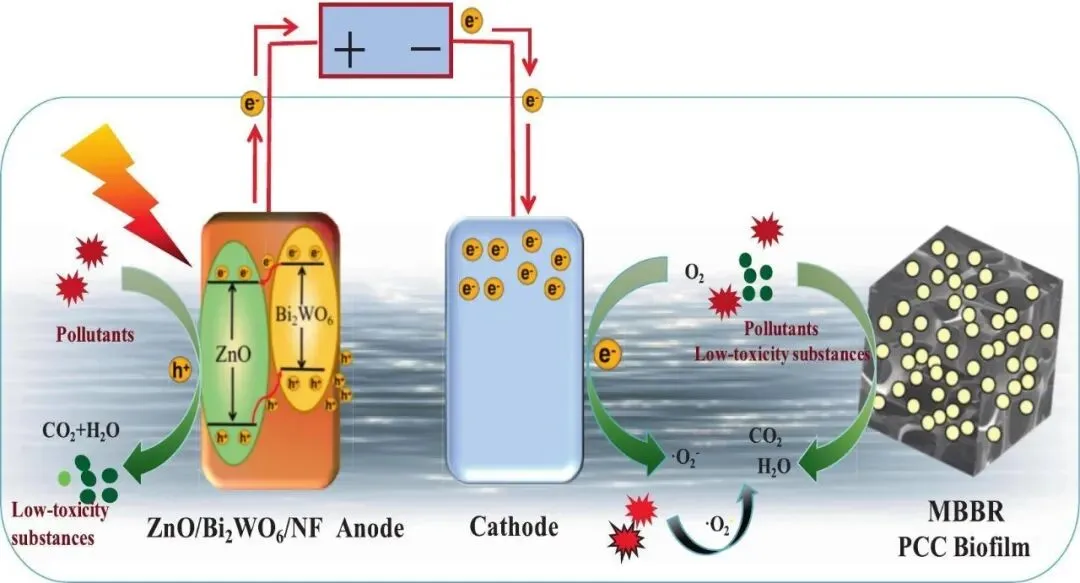
Photoelectrocatalytic Advanced Oxidation process (PEC-AOPs) utilizes light-induced electrocatalytic redox reactions to remove refractory pollutants from wastewater. The moving bed biofilm reactor (MBBR) employs suspended carriers as biofilm supports and degrade contaminants in wastewater by means of microbial metabolism. In this work, to address the challenges of high energy consumption, limited stability in PEC systems and relatively low wastewater treatment efficiency of MBBR processes for highly polluted wastewater, ZnO/Bi₂WO₆/Nickel foam (ZnO/Bi₂WO₆/NF) composite photoelectrode was fabricated to construct a PEC wastewater treatment system. Using porous polyurethane hydrogel (PPC) as a suspended carrier to establish a novel MBBR system. On this basis, the two systems were indirectly coupled to fabricate an integrated PEC-MBBR wastewater treatment system. The wastewater treatment performance and influencing factors of the two standalone systems and the PEC-MBBR integrated system were investigated. At an influent COD of 650 mg/L, the standalone PEC and MBBR systems achieved COD removal rates over 78.7 % and 80.3 %, respectively, while maintaining stable operation. However, at elevated COD concentrations of 1500–2500 mg/L, the removal rates of the single systems rapidly declined to below 40 %, demonstrating the insufficient treatment capacity of PEC and MBBR systems for high-pollution wastewater. In contrast, under the same high-load condition (2500 mg/L), the integrated PEC-MBBR system reduced the effluent COD to 55 mg/L, achieving a removal rate of over 94.5 % and maintaining stable performance for 30 consecutive cycles. It also demonstrated broad adaptability and strong resistance to fluctuations in wastewater quality. Furthermore, the operational mode from PEC unit to MBBR system (PEC → MBBR) featured the advantages of low energy consumption and high treatment capacity. The mechanism behind synergistic enhancement of dyeing wastewater treatment efficiency by the PEC-MBBR system was proposed in this work.
光电催化高级氧化技术(PEC-AOPs)利用光诱导的电催化氧化还原反应去除废水中难降解有机物。移动床生物膜反应器(MBBR)则通过悬浮载体上富集的微生物代谢作用降解污染物。针对PEC系统能耗高、稳定性有限,以及MBBR工艺处理高浓度有机废水效率较低等问题,本研究制备了ZnO/Bi₂WO₆/泡沫镍(ZnO/Bi₂WO₆/NF)复合光电极构建PEC系统,并以多孔聚氨酯水凝胶(PPC)为悬浮载体构建新型MBBR系统,进而将两系统间接耦合,形成PEC-MBBR一体化处理工艺。研究系统考察了单独PEC、单独MBBR以及PEC-MBBR集成系统处理印染废水的效能及影响因素。结果表明,当进水COD为650 mg/L时,单独PEC和MBBR系统均可稳定运行,COD去除率分别达到78.7%和80.3%以上。然而,当进水COD提升至1500–2500 mg/L的高负荷条件时,单独系统的去除率迅速下降至40%以下,凸显了其处理能力的不足。相比之下,在同等高负荷条件下(进水COD 2500 mg/L),PEC-MBBR集成系统表现优异,可将出水COD降至55 mg/L,去除率高达94.5%以上,并能连续稳定运行30个周期。该集成系统还展现出广泛的进水水质适应性和优异的抗冲击负荷能力。此外,采用PEC单元后接MBBR单元(PEC → MBBR)的运行模式兼具能耗低和处理效能高的双重优势。本文最后提出了PEC-MBBR系统协同增强印染废水处理效率的作用机制。

 10个月宝宝每天需要喝多少奶粉?

